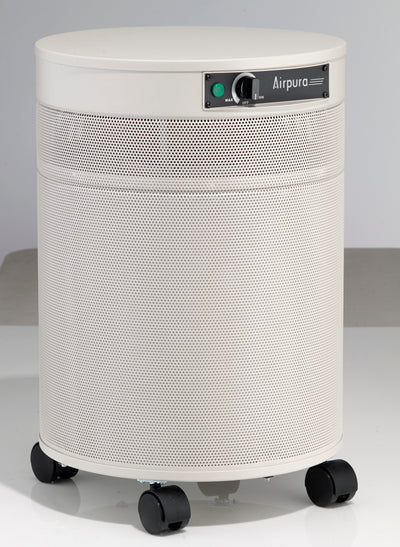
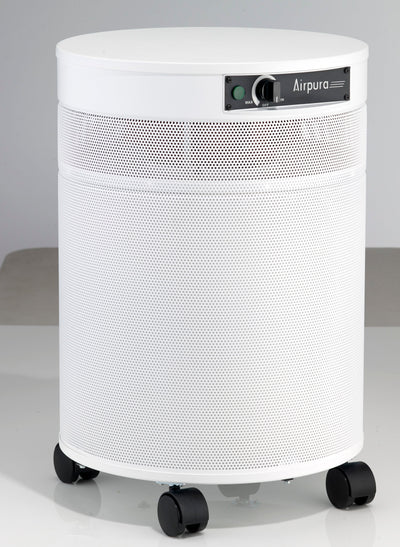
Short answer: VOCs are gases, so the number that matters is the carbon: how much there is and whether it is treated. A HEPA filter on its own does nothing for them. For one machine that handles VOCs and everyday particles in a main living area, start with the Austin Air HealthMate Plus. For the heaviest chemical load in a large space, the Airpura C600 carries 26 lbs of carbon.
What VOCs are, and why HEPA misses them
VOCs (volatile organic compounds) are gases given off by paint, new furniture and flooring, cleaning products, adhesives, fragrances and cooking. Because they are gases, they pass straight through a particle filter. The EPA's Guide to Air Cleaners in the Home says the same: to filter gases, choose an air cleaner with an activated carbon filter or another adsorbent filter. Activated carbon removes them by holding them on its surface, and once that surface is full, it stops working. That is why carbon is measured in pounds, not in layers. We compare the two filter types in HEPA vs activated carbon.
Treated (impregnated) carbon is chemically prepared to hold gases that plain carbon releases easily, such as formaldehyde and ammonia. If those are your concern, look for it by name.
What to look for
- Carbon in pounds. A thin carbon sheet fills up quickly. A deep bed measured in pounds keeps working far longer.
- Treated carbon if formaldehyde or ammonia is the problem.
- A sealed housing. Air that leaks around the filter is never cleaned.
- No ozone and no ionizer. Ozone can react with VOCs in the room and create new byproducts. Carbon holds the VOCs instead.
- The right size. Run it below its rated coverage and leave it on. We show the method in what size air purifier you need.
The machines we would point you at
| Model | Best for | Carbon | Particle filter | Coverage | Price |
|---|---|---|---|---|---|
| Austin Air HealthMate Plus | VOCs plus allergens in a main room | 15 lbs, treated blend | True HEPA | Up to 1,500 sq ft (750 at two air changes) | $894.99 |
| Airpura V600 | VOCs and chemical fumes, large spaces | 18 lbs, impregnated | True HEPA | About 2,000 sq ft | $999.98 |
| Airpura C600 | The heaviest chemical load | 26 lbs, activated | HEPA Barrier (95% at 1 micron) | About 2,000 sq ft | $1,049.98 |
| Airpura F600 | Formaldehyde from new flooring or furniture | 18 lbs, formaldehyde blend | True HEPA | About 2,000 sq ft | $1,049.98 |
| Airpura G600 | Chemical sensitivity, odor-free carbon | 18 lbs, German carbon | True HEPA | About 2,000 sq ft | $1,099.98 |
| Austin Air HealthMate Plus Junior | VOCs in a bedroom | Treated blend | True HEPA | Up to 700 sq ft (350 at two air changes) | $659.99 |
Airpura rates coverage at two air changes an hour with 8-foot ceilings.
Which one to buy
- Renovation, new furniture or a new home, plus allergies: the HealthMate Plus. One filter rated for five years, so there is nothing to replace for a long time.
- A large open space with strong chemical smells: the V600, or the C600 if the load is heavy and fine particles matter less.
- Formaldehyde specifically: the F600. Our formaldehyde guide goes deeper.
- Diagnosed chemical sensitivity: the G600, whose carbon is chosen to have no smell of its own. See our chemical sensitivity guide.
- One bedroom: the HealthMate Plus Junior.
Common questions
How fast will it clear a paint or new-furniture smell?
It depends on how much is still off-gassing. New materials keep releasing VOCs for weeks or months, so the machine works best running continuously from day one, alongside fresh air from open windows when you can.
How do I know when the carbon is used up?
The smell comes back while the machine is running. Heavy chemical loads use carbon faster than the rated life assumes.
Can I try it first?
Cooking on gas? The EPA lists gas stoves as a main indoor source of nitrogen dioxide. See air purifiers for a gas stove for why venting comes first.
Yes. Run it in your home for 30 days. If it is not right, we pay the return shipping and refund you in full. Shipping is free.