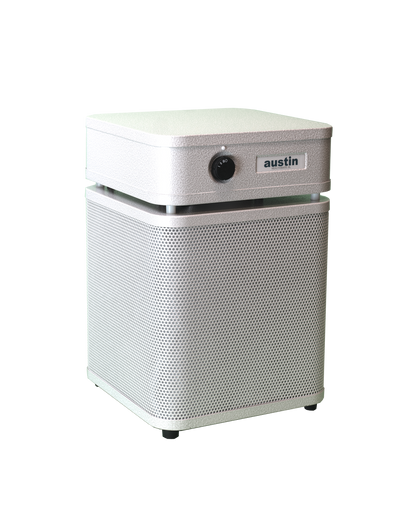
Measure the room, decide how hard the purifier has to work, and buy for the room size at that workload. The biggest number on the box usually assumes the air is cleaned only once or twice an hour. Below is how to read coverage figures, the EPA's rule of thumb, and a table of what each machine we sell is rated for.
Want the answer for your own room? The air purifier size calculator does the math in two taps.
Step 1: measure the room
Multiply length by width. A 12 by 15 foot bedroom is 180 sq ft. A 20 by 25 foot open living and kitchen area is 500 sq ft. If the room is open to another space with no door between them, count both, because the air moves between them.
Airpura's figures assume 8-foot ceilings, the usual basis for coverage ratings. With higher ceilings there is more air to clean, so scale up: a 10-foot ceiling holds a quarter more air than an 8-foot one.
Step 2: understand air changes per hour
An air change means the purifier has moved a volume of air equal to the whole room through its filters once. Coverage is always quoted at some number of air changes per hour, and that number changes the answer a lot.
- Austin Air quotes its standard machines at 1,500 sq ft for one air change an hour and 750 sq ft for two.
- Airpura quotes its machines at two air changes an hour with 8-foot ceilings: about 1,000 sq ft for the 400 series, 2,000 for the 600 series and 2,500 for the 700 series.
The same machine cleans half the floor area if you want the air cleaned twice as often. So compare machines at the same number of air changes, or the bigger number on one box means nothing.
Step 3: the EPA's rule of thumb
The EPA suggests a clean air delivery rate (CADR) of at least two-thirds of the room's area in square feet: a CADR of 200 for a 300 sq ft room. In an 8-foot room, that works out to roughly five air changes an hour. The EPA's wildfire cleaner air room fact sheet uses this rule for smoke.
Austin Air and Airpura do not publish CADR ratings for these machines. They rate them by air changes instead. To compare against the EPA rule, take the maker's two-air-change figure and multiply by 0.4. That is our arithmetic from the makers' own numbers, not a rating from either maker, so treat it as an estimate.
How many air changes do you need?
- General freshness and light dust: two an hour is a sensible floor.
- Allergies, asthma, pets: two or more, and more is better. See our guides for asthma and allergies.
- Wildfire smoke: the EPA rule, which is roughly five. See wildfire smoke.
- Chemicals and odors: airflow matters, but so does how much carbon the air passes through. See how much carbon you need.
What each machine is rated for
| Machine | 2 air changes an hour (maker) | About 5 an hour (our estimate) |
|---|---|---|
| Austin Air HealthMate Junior and HealthMate Plus Junior | 350 sq ft | About 140 sq ft |
| Austin Air HealthMate, HealthMate Plus, Bedroom Machine and Immunity Machine | 750 sq ft | About 300 sq ft |
| Airpura 400 series, such as the R400 | About 1,000 sq ft | About 400 sq ft |
| Airpura 600 series, such as the R600 | About 2,000 sq ft | About 800 sq ft |
| Airpura 700 series, such as the R700 | About 2,500 sq ft | About 1,000 sq ft |
Two-air-change figures are from Austin Air and Airpura. The five-air-change column is the maker figure multiplied by 0.4.
Worked examples
A 180 sq ft bedroom, allergies. Any of the full-size Austin Air machines covers it at more than five air changes. The HealthMate Junior covers it at two and more.
A 500 sq ft open living area, pets. A full-size Austin Air machine gives about three air changes. An Airpura 600 series gives more than five.
A 300 sq ft room during wildfire smoke. A full-size Austin Air machine or an Airpura 400 series meets the EPA rule by our estimate.
A 1,200 sq ft great room with 10-foot ceilings. That is the air of a 1,500 sq ft room with 8-foot ceilings. An Airpura 700 series gives about three air changes. For more, use two machines at opposite ends of the room.
Once it is sized, placement and speed matter as much: see where to put an air purifier, and how long to run it.
How fast a well-sized machine works, in minutes: how long an air purifier takes to clean a room.
Common questions
Is it better to buy a bigger air purifier than I need?
Usually, yes. A larger machine reaches the same number of air changes at a lower, quieter fan speed. The EPA notes that CADR is typically measured at a purifier's highest speed, so a machine that only meets your room at full speed will fall short whenever you turn it down.
Can one air purifier clean a whole house?
Not well. A portable purifier cleans the room it is in, plus whatever air drifts through an open doorway. For a whole floor, put one machine in each main room you use, starting with the bedroom.
Should I run it on high?
Run it all the time, and as high as the noise allows. The EPA recommends the highest setting during wildfire smoke. Every figure above assumes the machine is running.
What if my room is between two sizes?
Size up. The cost of an undersized machine is air that never gets clean enough. The cost of an oversized one is that you can run it on a lower setting.
Want the answer for your room without the arithmetic? Use our room match tool, or email support@freshhomeair.com with the room size and what you are dealing with, and Nolan will answer it himself. Every machine ships free and comes with a 30-day home trial.