Almost every air purifier sold says it has activated carbon. Very few say how much. That one missing number is the difference between a machine that handles odors for years and one that stops working in a few months without telling you.
Here is what the number means, how much you need, and how to check it before you buy.
What carbon does, and what it does not
HEPA and carbon do two completely different jobs.
HEPA is a mechanical filter. It physically traps particles: pollen, dust, dander, mold spores, smoke particulate. A true HEPA filter captures 99.97% of particles at 0.3 microns, and it does that on day one and on day one thousand.
Carbon does not trap particles. It adsorbs gases: odors, volatile organic compounds off-gassing from furniture and paint, cooking smells, smoke odor, the musty smell mold produces. Gases pass straight through HEPA. Only carbon removes them.
This matters for allergies specifically. If your symptoms are sneezing and itchy eyes from pollen or dander, HEPA is doing the work. If what bothers you is also the smell, a damp basement, a litter box, new flooring, cooking that lingers, then that is carbon, and the amount you have decides how long it keeps working.
Carbon fills up. That is the whole problem
A HEPA filter gets dirtier and keeps filtering. Carbon is different: it has a fixed number of sites that gas molecules can stick to, and when they are full, it stops adsorbing. It does not slow down gradually in a way you notice. It just quietly stops, and the smell comes back.
How long that takes is almost entirely a function of how much carbon is in the machine.
Most residential air purifiers carry one to five pounds. Many carry a thin carbon-coated mesh wrapped around the HEPA, and that is measured in grams, not pounds. It will take the edge off a smell for a few weeks. It is not built to hold a chemical load for years.
How much you actually need
There is no single right answer, but there is a useful ladder.
Under a pound, or a carbon-coated wrap. Fine for a mild, occasional smell in a small room. Expect to replace it often. If odor is the reason you are buying, this is not enough.
One to five pounds. The industry norm. Workable for a bedroom with light odor. In a kitchen, a basement, or a home with pets, it saturates faster than most people expect.
Six to fifteen pounds. Enough to hold a real, continuous odor load (pets, cooking, musty basements, smoke that drifts in) for years rather than months.
Eighteen pounds and up. This range exists for chemical sensitivity, heavy VOC off-gassing, and large open-plan spaces where the machine is working against a bigger volume of air.
The honest summary: if odor or chemicals are the reason you are buying, start looking at machines that publish a carbon weight in pounds. If a listing does not state the weight, that is usually the answer.
Why weight is the number, not the word
Two more things to check once you know the weight.
Is the carbon in a bed or a wrap? A deep bed gives the air contact time with the carbon, which is what actually lets adsorption happen. A thin wrap around a HEPA gives the air a fraction of a second. Same material, very different result.
Is the cabinet sealed? Air takes the easiest path. If a machine's housing leaks, some of the air goes around the filter rather than through it, and the carbon never sees it. Sealed steel cabinets exist for this reason.
Is the carbon treated? Standard activated carbon handles most odors and VOCs. For formaldehyde, ammonia and similar, carbon is chemically impregnated so it breaks those compounds down rather than only holding them. That is a different product, and it is what chemical sensitivity buyers are usually looking for.
Which machines we would point you at
We sell two brands and both publish their carbon weights, so you can check every number here.
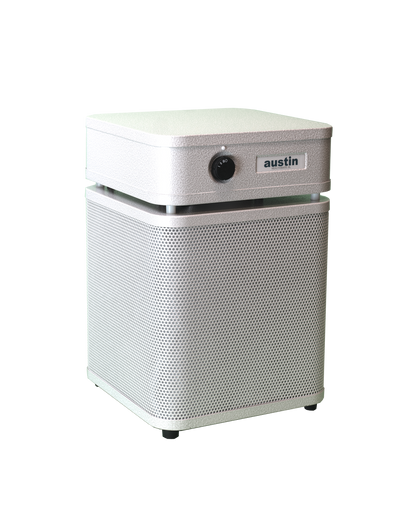
If odors, fumes or chemicals are part of the problem: the Austin Air HealthMate Plus, 15 lb of treated carbon blend, $894.99. It carries the same 15 lb as the HealthMate below, but the blend is impregnated for formaldehyde and ammonia, the treated carbon described above. Its single filter is rated for five years, and it is the model our customers buy most.
For dust, pollen and everyday odors: the Austin Air HealthMate, 15 lb of activated carbon, $844.99. Fifteen pounds is three to fifteen times what a machine in that one-to-five-pound range carries, and it is the reason the filter is rated for five years. It covers up to 750 sq ft at two real air changes an hour. If chemicals are not a concern, this is the default.
For one room, on a smaller budget: the Austin Air HealthMate Junior, 6.5 lb, $609.99. The same filter stack and the same sealed steel cabinet in a smaller body, covering up to 350 sq ft at two air changes. Six and a half pounds in a unit this size is still more than many full-sized machines carry.
For chemical sensitivity or a large open space: the Airpura C600, 26 lb of activated carbon, $1,049.98. This is the heaviest carbon load we stock. Airpura rates it for 2,000 sq ft at two air changes an hour. If you want carbon chemically treated for formaldehyde and ammonia as well, the C600 DLX carries the same 26 lb as impregnated carbon.
Sizing it to the room
Austin Air rates coverage at one air change an hour, and Airpura rates at two. One air change does not clear a room; two is what actually keeps up. Every square-foot figure above is given at two air changes, so it is the number we would stand behind.
A machine that is undersized for the room runs on high constantly, which is louder and saturates the carbon faster. Buying one size up is usually cheaper over five years than replacing filters early.
When carbon is not the answer
If a smell is strong and comes from one spot, find the source first. Carbon will reduce a musty basement smell, but it will not stop mold growing behind a shower surround, and it cannot keep up with an active moisture problem. The same is true of a gas leak, a sewer smell, or a dead animal in a wall. Those are repairs, not filtration.
Carbon also does nothing for carbon monoxide. That needs a detector, not a purifier.
If you tell us the room and what you are trying to get rid of, we will tell you which machine fits, and if a smaller one will do the job, we will say so.