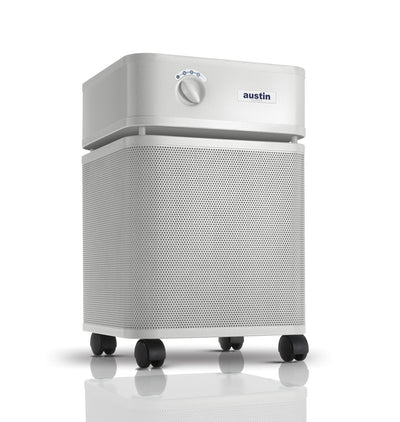


Short answer: an air purifier is not a COPD treatment, but there is a real trial behind using one. In a blinded Johns Hopkins study of 116 former smokers with moderate-to-severe COPD, people given working HEPA and carbon air cleaners had fewer moderate flare-ups and used their rescue medication less over six months than people given sham machines, though the study's main quality-of-life score did not differ across everyone enrolled. The machine in that trial was the Austin Air HealthMate (model HM400, $844.99, up to 750 sq ft at two air changes an hour), the same model number we sell. The benefit was clearest in people who ran it most of the time, so whatever you buy, size it for the room and leave it on.
What the COPD air cleaner trial found
The study is the CLEAN AIR trial, run by researchers at Johns Hopkins and published in 2022 in the American Journal of Respiratory and Critical Care Medicine (free full text). Each participant received two Austin HealthMate HM400 air cleaners with HEPA and carbon filters, or two sham units with the filters taken out that looked and sounded the same. One went in the bedroom and one in the room where the person spent the most time. Participants and the staff assessing them did not know which they had. The paper thanks Austin Air for donating the machines and states that the company had no input on the design, analysis or write-up.
What it found, in the authors' own terms:
- The main outcome, the total score on a standard COPD quality-of-life questionnaire, did not differ significantly between the two groups across everyone enrolled.
- The active group had a lower rate of moderate exacerbations (an incidence rate ratio of 0.32) and lower rescue medication use (0.54), and fewer respiratory symptoms.
- Among people who used the air cleaner more than 80% of the time, the main outcome did improve significantly.
- People who spent more time indoors were more likely to benefit.
It was one small trial, and the authors call the benefits "potential." We think that is the honest way to describe it.
The EPA's position fits with it. Its indoor particulate matter page says people with lung diseases such as COPD may be at greater risk from particle exposure. Its Guide to Air Cleaners in the Home says portable HEPA cleaners have shown small improvements in respiratory health in several studies, that the improvements are typically small, and that filtration does not replace removing sources and ventilating.
None of this replaces your inhalers, oxygen or anything else your doctor has prescribed.
What to look for
- True HEPA, stated as a number. 99.97% of particles at 0.3 microns, or better. "HEPA-type" has no fixed standard behind it.
- No ozone, ever. The EPA calls ozone a lung irritant and says to avoid air cleaners that intentionally produce it. Ionizers and some UV designs can emit it too. See ionizer vs HEPA.
- Enough airflow to run on a comfortable setting. The benefit in the trial tracked with how much people used the machine. A purifier sized right for the room can run all day without being turned off for noise.
- Carbon if smoke, cooking or fumes are part of the picture. HEPA does not capture gases. Gas stoves, cleaning products and wildfire smoke all add gases to indoor air.
- Little upkeep. A filter you have to change every few months is a filter that gets put off. Austin Air rates its filters for up to five years.
Size it for two air changes an hour
A purifier only cleans the air that passes through it. Makers often quote coverage at one air change an hour, the largest room the machine can technically serve. Size for at least two. Our size calculator uses four for asthma, smoke or chemical sensitivity, and if your COPD flares with smoke or fumes, that is the safer target: pick a machine rated for twice your room.
| Machine | Particle filter | Carbon | Coverage at 2 air changes an hour | Regular price |
|---|---|---|---|---|
| Austin Air HealthMate | True HEPA, 99.97% at 0.3 microns | Up to 15 lbs, gas and odor media | Up to 750 sq ft | $844.99 |
| Austin Air HealthMate Plus | True HEPA, 99.97% at 0.3 microns | Up to 15 lbs, part treated for chemical gases | Up to 750 sq ft | $894.99 |
| Austin Air HealthMate Junior | True HEPA, 99.97% at 0.3 microns | Activated carbon | Up to 350 sq ft | $609.99 |
| Airpura R614 | Super HEPA, 99.99% at 0.3 microns | 18 lbs | About 2,000 sq ft | $899.98 |
Coverage is each maker's own figure. Airpura lists about 2,000 sq ft for the 560 CFM R614, roughly two air changes an hour with 8-foot ceilings. For the full method, see what size air purifier you need. None of these four has an ionizer, a UV lamp or any ozone output. All three Austin Air filters are rated for up to five years.
Which one to buy
- A bedroom or living room: the HealthMate. It is the model the trial used: True HEPA, up to 15 lbs of gas and odor media, a steel housing and one filter rated for up to five years.
- A gas stove, a smoker in the house, or strong cleaning and fragrance smells: the HealthMate Plus. Same machine, with carbon treated for chemical gases. Our HealthMate vs HealthMate Plus guide explains the difference.
- A small bedroom up to 350 sq ft: the HealthMate Junior.
- A large open living area where you spend most of the day: the Airpura R614, with Super HEPA and the largest coverage of the four.
Where to put it
The trial put one machine in the bedroom and one in the room where each person spent the most time, and found more benefit in people who spent more time indoors. Copy that layout if you can: bedroom first, then the room with the chair or sofa where you sit during the day. A HealthMate in each is $1,689.98. Keep it a little away from the wall with nothing blocking the intake, and close the door while it runs so it is cleaning one room, not the whole house. Our guide on where to put an air purifier has the detail.
Common questions
Can an air purifier help COPD?
The best evidence says it may help some people with flare-ups, symptoms and rescue medication use, and that it helps most when it runs most of the time. It did not improve overall quality-of-life scores across everyone in the trial. It is a supplement to your treatment, not part of it.
Should I run it all day and all night?
Yes. In the trial, people who used the machine more than 80% of the time saw the clearest benefit. The EPA guide also notes that longer run times filter more air.
Is HEPA enough, or do I need carbon?
HEPA handles particles, which the EPA ties to greater risk for people with lung disease. The trial's machines had carbon as well, aimed at nitrogen dioxide, a gas the EPA lists from gas stoves and other combustion. If you also live with smoke, cooking fumes or chemical smells, add carbon, because HEPA does not capture gases. Our gas stove guide covers that case.
Is a "medical grade" purifier better for COPD?
It is not a rating printed on a box, so check what sits behind the words: True HEPA at 99.97% or better, a real carbon bed, and no ionizer, ozone or UV. We explain the test in what makes an air purifier medical grade.
Can I try it first?
Yes. Run it at home for 30 days. If it is not right, we pay the return shipping and refund you in full. Shipping is free.
Not sure which size fits your room? Use the air purifier size calculator: enter the room and it recommends one machine. Or email support@freshhomeair.com and Nolan will answer himself.