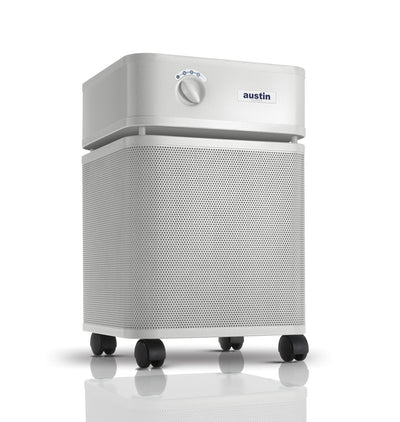
Short answer: a PM2.5 air purifier is any purifier with a filter that captures fine particles, 2.5 micrometers across and smaller. True HEPA is the standard to look for: it is rated to capture 99.97% of particles at 0.3 microns, the size that is hardest to catch. Size it for the room by CADR or air changes per hour, and run it all the time. For most rooms, our first pick is the Austin Air HealthMate, True medical-grade HEPA in a steel cabinet with a filter designed to last up to five years.
What is PM2.5?
PM2.5 is the EPA's name for fine inhalable particles, "with diameters that are generally 2.5 micrometers and smaller." The EPA puts it in scale: the average human hair is about 70 micrometers across, about 30 times larger than the largest fine particle. Indoors, PM2.5 comes from smoke (wildfire, tobacco, wood stoves, candles), cooking and outdoor air that gets in.
The EPA says that of the particles small enough to inhale, PM2.5 poses "the greatest risk to health."
A purifier for PM2.5 needs a real particle filter. Our allergy and asthma collection groups the machines built around one.
Do air purifiers remove PM2.5?
Yes, if they have a HEPA-class filter and are sized for the room. The EPA's guide to air cleaners says portable air cleaners often reach a high CADR by using a HEPA filter, and that the higher the CADR, the more particles a cleaner can filter. It also says that the longer an air cleaner runs, the more air it filters.
What a purifier does not do: it does not stop particles coming in, and it does not clean the air in other rooms. Close the windows on smoky days and put the machine where you spend the most hours.
For a bedroom, the Austin Air HealthMate Junior is the compact True HEPA option, rated by Austin Air for up to 700 sq ft at one air change an hour, about 350 sq ft at two.
What is the best air purifier for PM2.5?
For most rooms: Austin Air HealthMate, $844.99. True medical-grade HEPA rated to capture 99.97% of particles at 0.3 microns; Austin Air also states 99% down to 0.1 microns. Up to 15 lbs of gas and odor media for the smell that comes with smoke. Austin Air rates it for up to 1,500 sq ft at one air change an hour, about 750 sq ft at two. Made in Buffalo, New York.
Good fit: wildfire smoke days, city traffic, a living room or bedroom. Skip it if: you need one machine for a large open floor. The Airpura below moves more air.
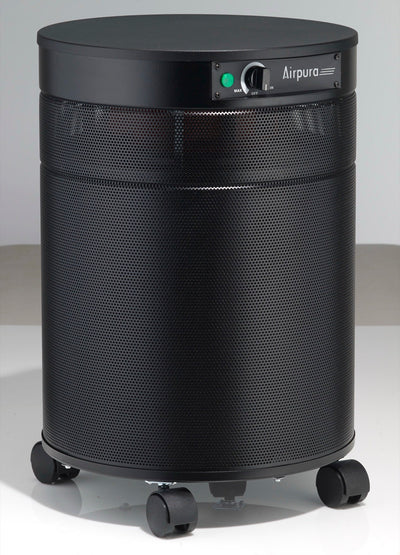
For a large open space: Airpura R600, $849.98. True HEPA and 18 lbs of activated carbon at 560 cfm. Airpura rates it for up to 2,000 sq ft. Built in Laval, Quebec, near Montreal.
Good fit: an open-plan floor where one machine has to cover a lot of space. Skip it if: it is for one small bedroom.
For the finest filter grade we carry: Airpura R614, $899.98. The R600 platform with Super HEPA, which Airpura rates at 99.99% at 0.3 microns.
Good fit: asthma or allergies where particle capture comes first. Skip it if: the extra 0.02% is not worth $50 to you; the R600 is close.
Skip the Airpura C and T series for PM2.5 alone: they are built around 26 lbs of carbon and use a HepaBarrier that captures about 95% of particles.
How do you size an air purifier for PM2.5?
The EPA's rule of thumb is a smoke CADR of at least two-thirds of the room's floor area, based on an 8-foot ceiling. A 300 sq ft room needs at least 195 cfm. Neither Austin Air nor Airpura publishes CADR, so for our machines we use each maker's room rating at two air changes an hour, and suggest more for smoke. The full method is in what is CADR, and our size calculator does the math for your room.
PM2.5 on wildfire smoke days
Check the Air Quality Index for your ZIP code on AirNow. On bad days, keep windows shut, run the purifier on high in one room, and spend as much time there as you can. Skip frying, candles and incense, which add their own fine particles. More steps in our wildfire smoke guide.
For a smoke-day clean room, the HealthMate covers both the particles and the smell.
Common questions
Is HEPA enough for PM2.5?
Yes. True HEPA is tested at 0.3 microns, well below 2.5 micrometers, and captures 99.97% at that size.
What does PM2.5 mean on an air quality monitor?
The concentration of fine particles in the air, usually in micrograms per cubic meter. A monitor shows the problem. A purifier with HEPA lowers it.
Does a purifier remove PM10 too?
Yes. Larger particles are easier to catch, and the pre-filter takes much of the coarse dust.
Does PM2.5 include smoke smell?
No. PM2.5 is particles. Smoke smell is mostly gases, which need carbon. See our odor and smoke smell guide.
How long should I run it?
All the time, on the highest speed you can live with. The EPA says longer run times and higher fan speeds filter more air. See how long to run an air purifier.
Sources: EPA, Particulate Matter (PM) Basics and Guide to Air Cleaners in the Home (read November 23, 2026); Austin Air and Airpura product pages (read November 23, 2026). Prices are our regular prices on November 23, 2026. Room sizes are the makers' own ratings.
Ready to choose? Start with the Austin Air HealthMate. It ships free with a 30-day home trial.