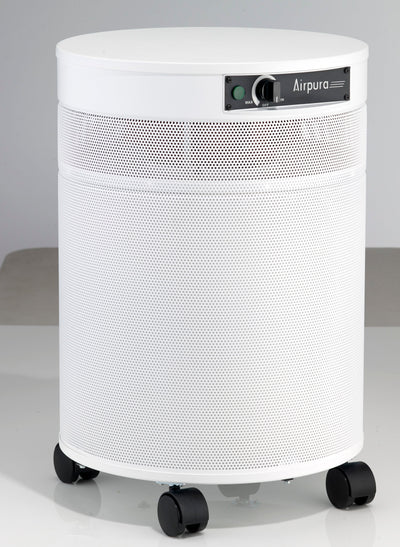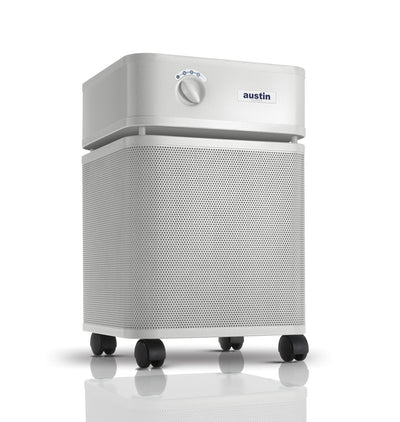
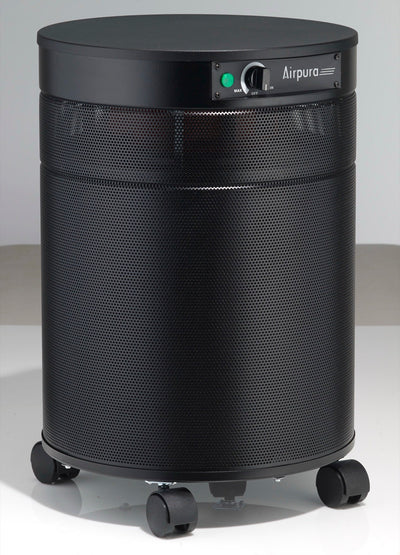


Short answer: litter box smell is mostly ammonia and other gases, and a HEPA filter does nothing about gases. What helps is a heavy bed of activated carbon in the same room as the box, plus scooping every day. Of what we sell, the Airpura V600 is our first pick for a strong litter box smell: Airpura names ammonia for its V series, and ammonia is what cat urine breaks down into. For a mild smell or a box in a shared room, the Austin Air HealthMate does the job, with True HEPA for litter dust and up to 15 lbs of gas and odor media for the smell.
Why a litter box smells
Fresh cat urine does not smell very strong. The sharp smell comes later, when bacteria in the litter break down the urea in urine into ammonia. That is why a box smells worse the longer it goes between cleanings, and why a warm, closed room makes it worse.
Ammonia is a gas. So are the sulfur compounds from feces. A gas molecule is far smaller than anything a particle filter is built to catch. The EPA puts it plainly in its guide to air cleaners: "To filter gases, choose a portable air cleaner with an activated carbon filter or other filter designed to remove gases."
Litter dust is different. Clay and silica litters throw up fine dust every time a cat digs, and that dust is a particle. True HEPA catches it. So the ideal machine for a litter box has both: HEPA for the dust, a lot of carbon for the smell.
Why carbon weight decides it
Carbon holds a gas on its surface. Each pound has a fixed amount of surface, so a thin carbon pad fills up in weeks when it sits next to a source that never stops. A litter box never stops. That is the case for a deep carbon bed measured in pounds, not a carbon-dusted sheet.
There is one more catch. Ammonia is a small, light molecule, and activated carbon holds it less well than most household odors. That is one more reason to keep the box clean. The purifier should be finishing the job, not doing all of it.
For more on how much carbon a machine needs, see how much activated carbon an air purifier needs.
The machines we would pick
For a strong litter box smell: Airpura V600, $999.98. True HEPA and 18 lbs of impregnated carbon at 560 CFM. Airpura names ammonia for its V series, and ammonia is what cat urine breaks down into. Airpura rates it for about 2,000 sq ft.
Good fit: a box you can smell from across the room, or several cats sharing one space. Skip it if: the smell is mild; the HealthMate below costs less and handles it.
For a mild smell or a box in a shared room: Austin Air HealthMate, $844.99. True HEPA and up to 15 lbs of gas and odor media in a steel cabinet. Austin Air rates it for up to 1,500 sq ft at one air change an hour, or 750 sq ft at two. The independent tester HouseFresh names it its pick for homes with multiple smelly pets (HouseFresh pet guide, Danny Ashton, updated October 2026). The same review notes it draws 147.6 watts on top speed.
Good fit: a box in a living area, a bedroom or a shared room, where the smell is mild. Skip it if: the box sits in a small laundry room or bathroom you can close off; the Junior below costs less and fits that space.
For a large open space or several boxes: Airpura R600, $849.98. True HEPA and 18 lbs of activated carbon at 560 CFM. Airpura's sales sheet rates it for about 2,000 sq ft. It holds as much carbon as the V600, as standard activated carbon rather than the V series blend.
Good fit: an open-plan floor with two or three boxes and a general pet smell. Skip it if: the problem is one box in one small room. You would be paying for airflow you do not need.
For a small room: Austin Air HealthMate Junior, $609.99. True HEPA and an activated carbon blend in a smaller cabinet. Austin Air rates it for up to 700 sq ft at one air change an hour, or 350 sq ft at two.
Good fit: a laundry room, a spare bathroom or a small bedroom where the box lives. Skip it if: the box is in your main living space. A full-size machine moves more air and holds more carbon.
Where to put the purifier
Put it in the same room as the box, a few feet away, with open space around it so air can reach the intake. Close enough that it pulls in the air around the box. Far enough that the fan does not blow litter dust around or bother the cat.
Some practical points:
- Do not put it inside a closet or cabinet with the box. It needs room to move air.
- If the box is in a small room, keep that door closed and let the machine work on that room.
- If the cat seems wary of the noise, start on low and turn it up over a few days.
- Keep the purifier away from the food and water bowls, for the same reason the box should be.
Our guide on where to put an air purifier covers placement in more detail.
The habits that do most of the work
A purifier catches what escapes. It cannot keep up with a box that is full. The ASPCA's litter box guidance covers the basics:
- Scoop every day. The ASPCA says to scoop "at least once a day."
- Wash the box weekly with warm water and unscented soap.
- One box per cat, plus one. Three cats means at least four boxes. Crowded boxes get used past the point where they smell.
- Skip scented litter and scented cleaners. The ASPCA warns that a cat can develop an aversion to the scent and stop using the box. A scent also only covers the ammonia; it does not remove it.
Do these first. Then the purifier has a small, steady job instead of an impossible one.
Covered box or open box?
A covered box keeps the smell in for you, but it holds it in for the cat, too, and some cats stop using a box that smells strong inside. If you use a covered box, scoop it every day without fail, because you cannot see or smell how full it is from the outside. An open box in a room with a purifier lets the machine reach the air around it.
Litter type matters too. Clumping litter lets you lift the urine out with each scoop, which takes the source of the ammonia out of the house every day. Non-clumping litter holds urine in the bed of litter until you change all of it, so it needs changing more often.
Do not use an ozone generator for litter smell
Some machines sold for pet odor work by making ozone. The EPA advises against them. It says that at levels that meet public health standards, "ozone is not effective at removing many odor-causing chemicals," and that ozone "can damage the lungs." Cats breathe the same air. Nothing we sell makes ozone or uses an ionizer.
How long to run it
A litter box makes smell all day, so run the purifier all day. Low or medium is usually enough once the room is under control. Turn it up for an hour after you scoop or change the litter, since that is when the most dust and smell go into the air. For more, see how long to run an air purifier.
Common questions
Do air purifiers work for cat litter smell?
Yes, if the purifier has a heavy carbon filter. The smell is a gas, and only carbon or another gas filter removes gases. A HEPA-only purifier will catch litter dust and dander but leave the smell.
Where should I put an air purifier for a litter box?
In the same room, a few feet from the box, with open space around the machine. Not in a closed cabinet, and not blowing straight at the box.
Will an air purifier help with ammonia from cat urine?
It helps, but it should not be the whole plan. Activated carbon holds ammonia less well than most odors, so a heavy carbon bed plus daily scooping works far better than either one alone.
Is an air purifier safe for cats?
A HEPA and carbon purifier only filters air, so it adds nothing to the room. Avoid ozone generators. If your cat is nervous around new machines, start on the lowest setting.
How often will I need to change the filter with a litter box?
A constant source like a litter box uses carbon faster than a normal room. Austin Air designs its main filter to last up to five years in normal use, and heavy odors can shorten that. When the smell comes back while the machine is running, the carbon is full.
For a house with more than one animal, see our guides to the best air purifier for multiple pets and the best air purifier for pets.
Sources: EPA, Guide to Air Cleaners in the Home; EPA, Ozone Generators that are Sold as Air Cleaners; ASPCA, Litter Box Problems; Austin Air and Airpura product specifications as listed on our product pages.