

Short answer: a wood stove or fireplace puts two things into your home: fine smoke particles and gases, including benzene, formaldehyde and acrolein, according to the EPA. Cut the smoke at the source first: burn only dry, seasoned wood, keep the stove door closed except when loading, and use an EPA-certified stove if you can. Then run an air purifier with True HEPA for the particles and a heavy carbon bed for the smell and gases, in the room with the stove. The EPA itself suggests a portable air cleaner for reducing wood smoke indoors. Of what we sell, the Austin Air HealthMate is our first pick for a living room with a stove.
What is in wood smoke
The EPA's Burn Wise program describes wood smoke as a mix of fine particles, also called particulate matter or PM, and toxic air pollutants including benzene, formaldehyde, acrolein and polycyclic aromatic hydrocarbons (PAHs). The fine particles are the main health concern: the EPA notes they can make asthma worse and trigger asthma attacks, and can also trigger heart attacks, stroke and irregular heart rhythms.
The EPA lists children, teenagers, older adults and people with lung or heart disease among those at greater risk. If someone in your home falls into one of those groups, the stove deserves extra care.
Cut the smoke at the source
A purifier cleans up what escapes. The less that escapes, the better. The EPA's best wood-burning practices are the place to start:
- Burn dry wood. The EPA says wood burns best at a moisture content under 20%, and suggests checking it with a wood moisture meter before you burn it. Wet wood smokes.
- Keep the doors closed. The EPA advises keeping the doors of a wood-burning appliance closed unless you are loading or stoking the fire, because harmful chemicals, including carbon monoxide, can be released into the home.
- Burn only wood. Never household trash, cardboard, plastic, foam, or painted, coated or pressure-treated wood.
- Use an efficient stove. The EPA says burning more efficiently, for example with an EPA-certified stove and dry, seasoned wood, creates less smoke.
- Have the chimney inspected and cleaned. A blocked or leaky flue pushes smoke back into the room.
Why you need both HEPA and carbon
Wood smoke is two problems at once. The fine particles need a True HEPA filter, rated to capture 99.97% of particles at 0.3 microns. The smell and the gases pass straight through HEPA, and only activated carbon or another gas filter takes them up. A machine with only one of the two leaves half the smoke behind. For a stove that runs all winter, the carbon should be measured in pounds, because a thin carbon sheet fills up quickly next to a constant source.
One thing no purifier does: carbon monoxide
No air purifier removes carbon monoxide. It is an odorless gas that carbon filters do not capture. Every home with a wood stove or fireplace needs a working carbon monoxide alarm, tested regularly. A purifier is for particles and smell, not for safety from CO.
The machines we would pick
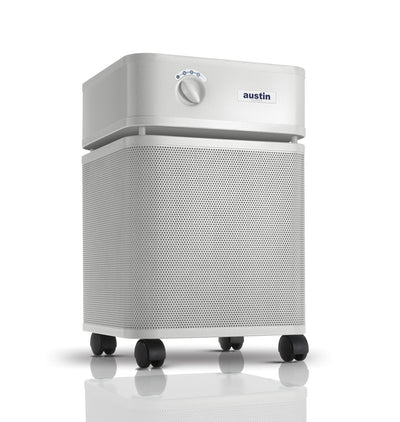
For a living room with a stove: Austin Air HealthMate, $844.99. Medical-grade HEPA rated to capture 99.97% of particles at 0.3 microns, a pre-filter and up to 15 lbs of gas and odor media in a steel cabinet. Austin Air rates it for up to 1,500 sq ft at one air change an hour, or 750 sq ft at two air changes an hour. HouseFresh's own test measured its PM2.5 clean air delivery rate at 154 cfm.
Good fit: a living room or den where the stove runs most evenings. Skip it if: the stove heats a large open-plan space; the R600 below moves more air.
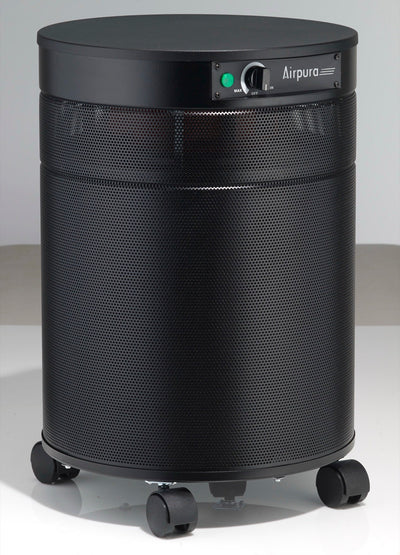
For a large open-plan room or cabin: Airpura R600, $849.98. True HEPA at 99.97% at 0.3 microns and 18 lbs of activated carbon at 560 CFM, in an all-metal cabinet. Airpura rates it for about 2,000 sq ft.
Good fit: a great room or cabin where the stove is the main heat source. Skip it if: the room is small; you would be paying for airflow you do not need.
For the bedroom next door: Austin Air HealthMate Junior, $609.99. The same medical-grade HEPA approach in a compact cabinet, rated by Austin Air for up to 700 sq ft at one air change an hour, or 350 sq ft at two air changes an hour.
Good fit: a bedroom that picks up smoke smell from the living area overnight. Skip it if: you only have budget for one machine; put the full-size one in the room with the stove.
All three ship free and come with our 30-day home trial.
How much purifier a stove room needs
Makers rate their machines by room size at a given number of air changes an hour, and those figures are the makers' own. For smoke, more air changes are better. One independent check: HouseFresh measured the Austin Air HealthMate's PM2.5 clean air delivery rate at 154 cfm. The EPA's rule of thumb for smoke is a clean air delivery rate of at least two-thirds of the room's area in square feet, which by our arithmetic puts the HealthMate at about 230 sq ft for heavy smoke. If your stove room is bigger than that and smoke is a real problem, use a larger machine or two machines. Our guide to what size air purifier you need shows the math.
What not to use
Skip ozone generators and ionizers sold for smoke. The EPA warns that ozone damages the lungs, and that when it reacts with chemicals indoors it can form harmful or irritating by-products. Scented candles and sprays only cover the smell while the smoke stays in the air.
Where to put it and how to run it
Put the purifier in the same room as the stove or fireplace, across the room from it rather than right beside it, with open space around the machine and well away from the heat. Turn it up when you light, load or stoke the fire, because that is when the most smoke escapes, and keep it running for a while after the fire dies down. The rest of the time a lower setting is fine.
Smoke from a neighbor's wood stove
If the smoke comes from outside, from a neighbor's chimney or a valley that fills with wood smoke on still winter nights, keep windows closed during the worst hours and run the purifier in the rooms you use most. The same HEPA and carbon combination applies. Our wildfire smoke guide covers sealing a room and reading the air quality index, which works the same way for wood smoke.
For the other things that make winter air worse, from gas stoves to carbon monoxide, see indoor air quality in winter.
Wood stove smoke: myths vs facts
Myth: an air purifier makes up for a smoky stove
Fact: fix the fire first. The EPA says to burn only dry, split, well-seasoned wood and to keep the stove doors closed unless you are loading or stoking the fire. A purifier then cleans what still gets into the room.
Myth: any HEPA purifier takes out the wood smoke smell
Fact: the EPA describes wood smoke as a mix of gases and fine particles. HEPA traps the particles. The smell and the gases need activated carbon, and a large amount of it.
Myth: a purifier protects you from carbon monoxide
Fact: no air filter removes carbon monoxide. The CDC advises battery-operated or battery back-up CO detectors near every sleeping area, and a yearly service for heating appliances by a qualified technician.
Common questions
How dry should firewood be?
The EPA says wood burns best at a moisture content under 20 percent. Season split wood for at least six months, store it outdoors with only the top covered, and check it with a moisture meter before you burn it.
Do air purifiers work for wood stove smoke?
Yes, if they have both True HEPA for the fine particles and a substantial carbon filter for the smell and gases. They work best alongside good burning habits that cut the smoke at the source.
Does an air purifier help with fireplace smoke?
The same way. An open fireplace usually puts more smoke into the room than a closed stove, so a purifier in that room is worth running whenever the fire is lit.
Will an air purifier remove creosote or chimney smell?
Carbon reduces the smoky smell in the air. It does not fix a dirty chimney. A strong creosote smell in the house, especially in summer or after rain, is a sign to have the chimney cleaned.
Does an air purifier remove carbon monoxide?
No. Use a carbon monoxide alarm. No air purifier removes carbon monoxide.
What about wood stove dust and ash?
Ash and fine dust from loading wood are particles, so True HEPA catches them once they are in the air. A pre-filter helps protect the HEPA from the heavier dust.
Should the purifier run when the stove is not lit?
A low setting is worth it. Smoke smell lingers in the room after the fire is out, and the EPA notes that the longer an air cleaner runs, the more air it filters.
Is it safe to run a purifier near a wood stove?
Keep it well away from the stove, the hearth and any hot surface, with open space around it, and follow the clearances in the purifier's manual. Across the room is the right distance, not next to the fire.
For smoke from cigarettes rather than wood, see our guide to the best air purifier for cigarette smoke.
Sources: EPA Burn Wise, Wood Smoke and Your Health; EPA Burn Wise, Best Wood-Burning Practices; HouseFresh, Austin Air HealthMate review (Danny Ashton, February 2026); Austin Air and Airpura product specifications as listed on our product pages.