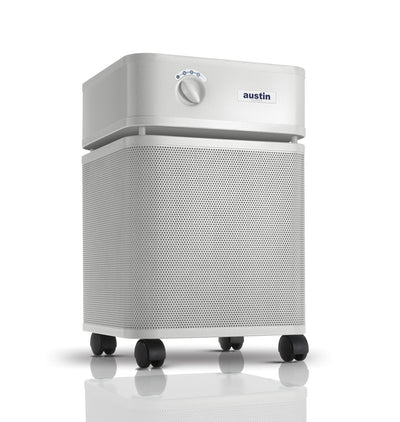


Short answer: yes, you can react to a Christmas tree. A live tree can carry mold, pollen and dust into the house, and its sap contains terpenes that bother some people's skin. The American College of Allergy, Asthma and Immunology (ACAAI) advises giving a live tree a thorough shake and rinse before you bring it inside, and cleaning an artificial tree to remove the dust and mold it collects in storage. A True HEPA air purifier reduces the fine particles that stay in the air, but it does nothing for sap on your skin and does not replace cleaning the tree. Of what we sell, the Austin Air HealthMate is our first pick for a living room with a tree.
Is Christmas tree allergy real?
Yes. In a 1970 study in the Canadian Medical Association Journal, Wyse and Malloch found that 7% of 1,657 allergic patients had respiratory or skin reactions to conifers. They described a seasonal syndrome of sneezing, wheezing and short-lived skin rashes. Most patients reacted within 24 hours, but 15% had symptoms only after several days. So if you start sneezing several days after the tree goes up, the tree can still be the cause. People call this "Christmas tree syndrome," but it is not one allergy. It is a reaction to whatever the tree brings in.
What on a tree can set you off
Mold
The ACAAI says some live trees still have mold spores and pollen on them, which can make nasal allergies flare. A 2011 report in the Annals of Allergy, Asthma and Immunology by Kurlandsky and colleagues, titled "Identification of mold on seasonal indoor coniferous trees," looked at the same question.
The older evidence is mixed. In the 1970 study, scrapings of pine and spruce bark grew large numbers of Penicillium, Epicoccum and Alternaria molds, but those spores did not become airborne, and the researchers found no significant change in airborne mold in homes with a tree. Mold on the tree is common. How much reaches the air you breathe likely varies by tree and home.
Pollen
Pine pollen is not the problem in December. Allergist Allen Meadows, MD, quoted by the ACAAI, says pine tree allergy is a springtime problem, and that by Christmas the tree pollens are gone. What bothers people at Christmas are other pollens caught on the branches, including weed pollens from the fall. The 1970 study also measured weed, grass and tree pollens released into the air while trees were in the house.
Terpenes and sap
The ACAAI says some people have contact skin allergies to terpene, a substance in the sap of real trees. The 1970 researchers thought the oleoresins in tree balsam were the most likely cause of the symptoms they saw. This is a skin contact problem. Wear gloves and long sleeves when you carry and decorate the tree.
Dust
Live trees pick up dust on the lot. For stored trees, the ACAAI says decorations stored in those places often collect dust, mold spores and other allergens.
Before a live tree comes inside
- Shake it. Ask the lot to run it through a shaker, or shake it hard yourself outside. The ACAAI recommends a thorough shake.
- Rinse it. The ACAAI says to rinse off live trees before bringing them into the house. A garden hose works.
- Let it dry first. Stand it in the garage or on a covered porch until the branches are dry before you bring it in. A wet tree adds moisture to a warm room, and the ACAAI's mold advice is to keep indoor moisture down.
- Keep it out of bedrooms. If someone reacts, put the tree away from where they sleep.
How long to keep it up
We found no verified safe number of days. Symptoms can be delayed: 15% of patients in the 1970 study reacted only after several days. If symptoms build the longer the tree is up, and ease when you are away from it, take it down early.
Artificial trees: dust and storage
An artificial tree takes pollen and live-tree mold off the table, and the ACAAI suggests considering one if you have a mold allergy. But it brings its own dust. The ACAAI's advice:
- Unpack decorations outside or in a well-ventilated space.
- Consider wearing an N95 mask while you clean the tree and other decorations.
- Use a handheld vacuum to gently remove dust from the artificial tree.
- Wipe hard surfaces with a damp cloth.
When the season ends, clean the tree before you pack it, and store it somewhere dry in a closed box or bag. Damp basements and garages are where stored decorations pick up mold.
Where a HEPA air purifier helps
An air purifier catches what is floating in the air. The EPA says portable air cleaners often reach a high clean air delivery rate by using a HEPA filter, and that the longer an air cleaner runs, the more air it filters. The EPA also reports that several studies with portable HEPA air cleaners found improvements in one or more allergy or asthma symptoms, though not major ones in every study and not in every symptom.
Run it in the tree room for the weeks the tree is up, and turn it up while you carry the tree in, unpack and decorate. That is when the most goes into the air.
Where it does not help
- Heavy particles that settle. The EPA says larger particles, including pollen and some mold spores, settle onto surfaces quickly, so air filters are not likely to remove them effectively, and allergen control needs routine cleaning and dust control. Vacuum the floor around the tree often.
- Sap on your skin. Terpene contact is a skin problem. Gloves help. A purifier does not.
- Mold growing in the house. The EPA says air cleaners do not solve mold problems, because mold comes from a moisture problem. A purifier may remove some particles from mold, but the source has to be fixed.
The machines we would pick
For the living room with the tree: Austin Air HealthMate. True HEPA plus up to 15 lbs of gas and odor media, made in Buffalo, NY. Austin Air rates it for up to 1,500 sq ft (about 750 sq ft at two air changes an hour).
Good fit: a family room where the tree stands all season. Skip it if: you want an extra UV layer on the filters; see the UV600 below.
For a bedroom: Austin Air Bedroom Machine. HEGA, a carbon cloth, plus True HEPA, made in Buffalo, NY.
Good fit: the bedroom of the person who reacts. Skip it if: you only want one machine; put it where the tree is.
If mold is the concern: Airpura UV600. HEPA plus carbon, with a UV-C germicidal lamp inside the cabinet. Airpura says the lamp sterilizes germs and mold spores trapped on the filters so they are not released back into the air. Airpura rates it for up to 2,000 sq ft. Made in Canada.
Good fit: someone with a mold allergy who wants HEPA and carbon plus an extra UV layer on the filters. Skip it if: you do not want a lamp to replace; Airpura says every 18 to 24 months.
All three ship free and come with our 30-day home trial.
Common questions
Can you be allergic to Christmas trees?
Yes. In the 1970 Wyse and Malloch study, 7% of allergic patients reacted to conifers. Most reactions come from mold, pollen and dust on the tree, or from terpenes in the sap, rather than from the tree itself.
What is Christmas tree syndrome?
A popular name for sneezing, wheezing or skin rash that starts after a tree comes into the house. An allergist can test for the actual trigger.
Is an artificial tree better for allergies?
For mold and pollen, often yes, and the ACAAI suggests one for people with a mold allergy. Clean it before you put it up, because dust and mold build up in storage.
Should I wash my Christmas tree?
The ACAAI says to rinse a live tree before bringing it in. Let it dry in the garage first so you are not bringing a wet tree into a warm room.
Do air purifiers help with Christmas tree allergies?
A True HEPA purifier reduces fine airborne particles in the room. It works best alongside shaking and rinsing the tree, vacuuming around it and keeping it out of bedrooms. It does not help with sap on the skin.
For mold beyond the holidays, see our guide to the best air purifier for mold, and for year-round triggers, the best air purifier for allergies.
Sources: Wyse and Malloch, Christmas tree allergy: mould and pollen studies, Canadian Medical Association Journal, 1970; Kurlandsky et al., Annals of Allergy, Asthma and Immunology, 2011; ACAAI holiday allergy, pine tree allergy and mold allergy pages; EPA, Guide to Air Cleaners in the Home; EPA, Residential Air Cleaners: A Technical Summary; Austin Air and Airpura product specifications as listed on our product pages.